
ImmoGirona
Both for sale and for rent and always with the best technology on the market. For individual clients, companies, investors, corporations, service providers, SOCIMIs, investment funds, promoters, asset holders, banks, etc.
Stay up to date with our latest news and products.
Technology
pol | Sept. 20, 2026, 5:49 p.m.
What if they told you that today you could start generating your own electricity at home from €100 ?
Attention: we are not talking about a €100 monthly fee linked to ten-year financing , but the actual purchase price and ownership of a solar panel. And not a cheap or discontinued panel, but the latest generation panels with Tier 1 classification (such as Jinko Solar or JA Solar) , N-Type Monocrystalline / PERC technology, double glass ( Dual Glass ) and efficiencies greater than 21%.
Photovoltaic technology has reached such a point of democratization that many homeowners in the Girona region are surprised when they discover the real costs without intermediaries.
It sounds like fiction, but the technical reality is incredibly simple. Taking this first step doesn't require great knowledge or taking any risks:
100% standard connectors: The panels use MC4 type connections that only have one possible position; it is impossible to get the polarity wrong.
No danger of "farts" or sparks: Don't worry, the microinverter knows exactly what to do. When you plug it into the network, it won't make a fart or spark. In fact, it needs to detect the current in your home network to automatically synchronize itself in frequency and phase before starting to inject any watts. You don't have to worry about anything: it takes care of it all by itself and does exactly what is needed.
Unbeatable proximity consumption: Due to the physics of electricity, electrons always seek the path of least resistance. If you plug in any household appliance that consumes 2,000 W (a dryer, compressor, oven or air conditioner) to the socket where you have connected the microinverter, 1 meter or 10 cm away, it will first take the energy that your panels are generating before going to pull electricity from the street network.
Alternating current (230V) a few meters away: Since the microinverter is designed to go outside and converts the energy to 230V there, there is no need for long runs of DC wiring. If the nearest and most protected socket is a few meters away, all you need is a well-covered hose to bring the electricity directly to your network.
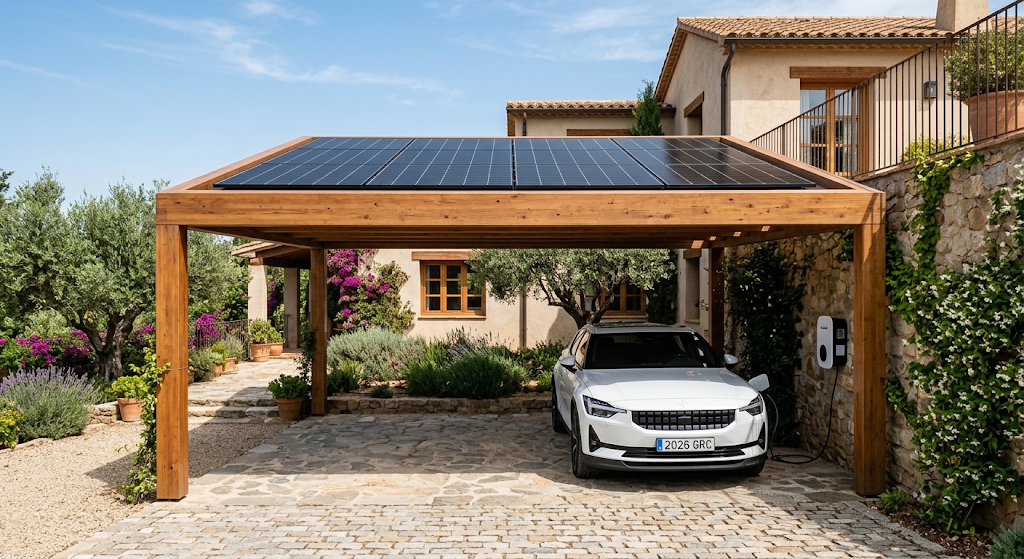
Think about this practical case: you have an electric or plug-in hybrid car parked in your driveway or garden. You put up a wooden or aluminum pergola to shade it, cover it with 8 solar panels and a pair of 4-input microinverters (like two Hoymiles HMS-2000, or four 2-input HMS-1000) , and all you need is a plug (or a well-sized power strip next to the charger).
While the car is parked during the sunny hours, the load is powered directly by the energy produced by the pergola a few centimeters away. You charge kilometers practically for free. And if you later add a battery system, you are already fully equipped to take advantage of this energy when you get home at night ( you can search for our article dedicated exclusively to the selection and installation of storage batteries on Immogirona ).
If you have such a space, a kit of 4 to 8 panels of this level can generate between 1,800 and 3,600 kWh per year for an initial investment of between €600 and €1,200 in material and, at most, two hours of work, taking into account that you are an absolute novice.
It's that simple. Now, is this the best option for any home or does an integrated project make more sense?
From there, the decision breaks down according to your goals as an owner:
If you are looking for operational efficiency and immediate savings: The DIY ( Do It Yourself ) or self-installation model allows you to cover summer consumption peaks (air conditioning, pool pumps, electric car) without making a large initial expense, managing to recover the investment in less than two years.
If you are looking for asset valuation, bonuses and zero complications: The "turnkey" model (with a typical cost of between €8,000 and €10,000) offers you the executed project, official legalization, access to the IBI bonus and a direct impact on the Energy Efficiency Certificate (CEE) of the property.
These are combinable options! Starting with the DIY model is not at all incompatible with doing a Turnkey installation later. In fact, they are 100% integrable: once you decide to do the big project and legalize it with a technician, your first DIY microinverter kit can be included in the installation certificate and will start injecting and compensating surpluses into the network exactly like the rest of the panels.
To determine which option best suits your owner profile, we analyze the strengths, weaknesses, opportunities and threats of each model:
Strengths:
Minimum entry cost: High-efficiency Tier 1 panels from €100/unit (owned, no fees) and 1.8 kWp installations for less than €800 complete.
Quick assembly: Two hours of work at most for a non-professional profile.
Unbeatable return on investment (ROI): Payback in 1.5 - 2 years by eliminating the most expensive energy band from your bill.
Simplicity and safety: Standard connectors, automatic synchronization of the microinverter without risk of sparks and consumption directly at the nearest socket.
Control and technical integration: Freedom to choose components (Hoymiles microinverters) and advanced home automation integration (Home Assistant, OpenDTU) to control production watt by watt.
Weaknesses:
Physical assembly: You must be responsible for fixing the structures or panels to the roof, pergola or garden.
Absence of initial automatic legalization: Without an Electrical Installation Certificate (CIE) signed by an authorized installer, you cannot initially opt for compensation for excess discharges or municipal tax credits (although it can be legalized a posteriori if the system is expanded).
Opportunities:
Ideal solution to eliminate non-subsidized consumption during the summer months (AACC, penguins, swimming pool, electric vehicle).
Total scalability: It can be used as a first learning step and later added to a legalized Turnkey installation.
Modular design with option to add custom storage (LiFePO4 batteries) at low cost in the future.
Threats:
Errors in anchoring or in the choice of wiring protection that could generate leaks in the roof or premature wear of the line.
Strengths:
100% administrative management: Execution of technical project, municipal licenses, registration with the distributor and processing of the CIE.
Tax and legal benefits: Allows access to compensation for excess bills, IBI discounts of up to 50% for 3-5 years in many Girona municipalities and personal income tax deductions.
Valuation of the property: Official improvement of the rating in the Energy Efficiency Certificate (CEE).
Weaknesses:
Much higher overall price: The cost is usually between €8,300 and €10,100 for complete residential projects.
Long repayment terms: Between 6 and 10 years to recover the investment.
Opportunities:
Directly computable increase in the sale or rental price of the home in the Girona real estate market (houses with the letter A or B).
Ability to absorb and legalize pre-installed DIY microinverter sets.
Threats:
Dependence on the approval deadlines of the administrations for the collection of subsidies or the application of the IBI discount.
In today's market there is no single answer, but a choice based on objectives:
Opt for the microinverter/DIY solution if you want a simple proof of concept, have an accessible space (such as a roof or pergola) and your primary goal is to drastically reduce your immediate electricity bill without committing capital (knowing that you can always integrate it later).
Opt for the Turnkey solution if your project is heritage-related, you want to increase the property's appraisal value, improve the CEE energy label and take advantage of the city council's tax credits without any management on your own.